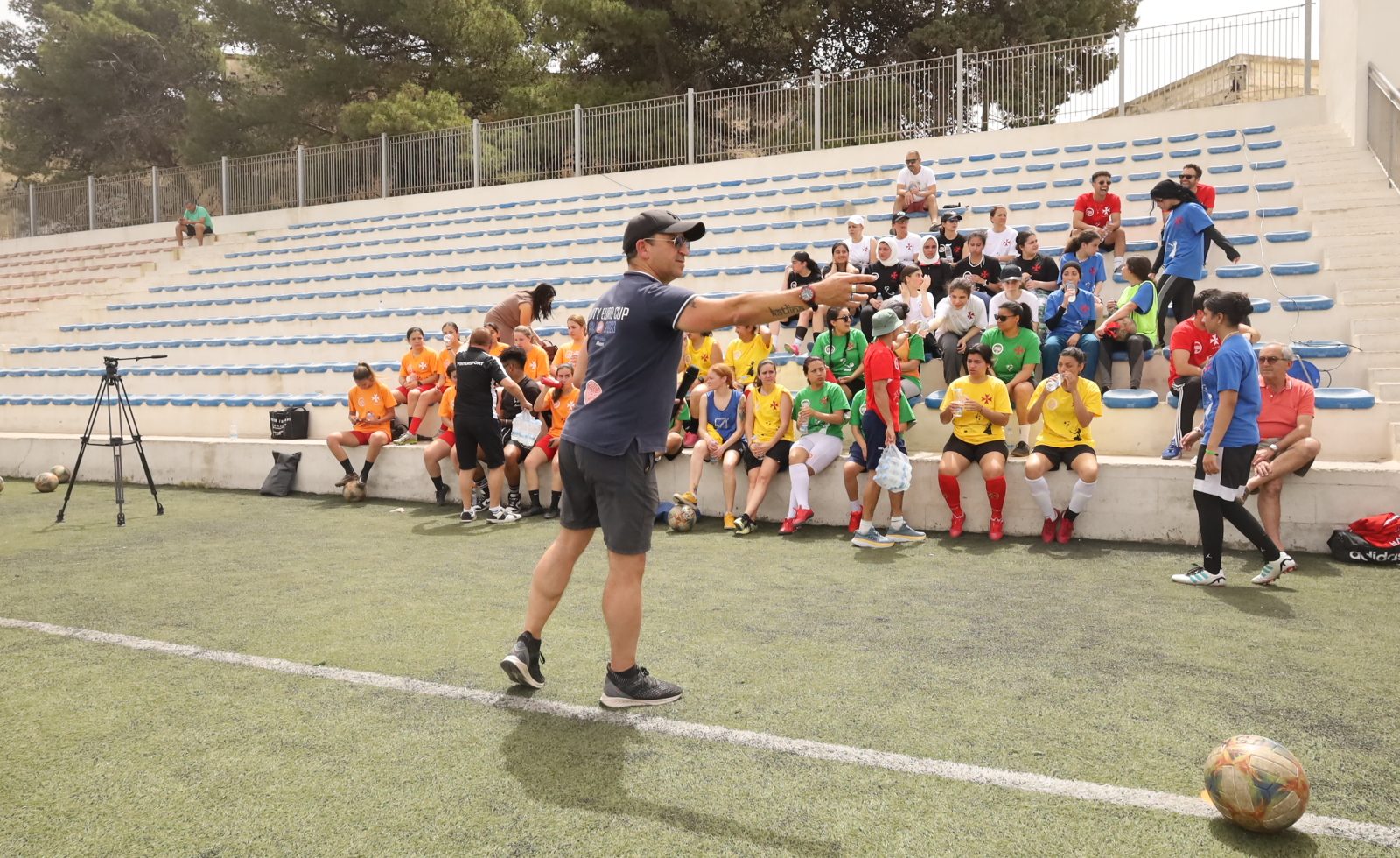
The Malta Football Association has recently launched a strategy on Football Social Responsibility (FSR) aimed at using the power of the ‘Beautiful Game’ to do good and leave positive legacies within the Maltese community.
Peter Busuttil, Director at Malta FA’s FSR, said that the strategy was a requirement from UEFA and recently he met with officials from the European governing body football to discuss what applies to the Maltese system and be applied in our strategy.
“The document is based on the work carried out by the Malta FA during the last five years,” Busuttil told the Times of Malta.
“In the past, Football and Social Responsibility was not so present in the Maltese system but during the past five years we have worked on several projects that involved various sectors of our society such as refugees, people with disability, government institutions, as well as elderly people, just to name a few.
“We tackled domestic violence, early school leavers, we had two projects on radicalism, even though it’s not a major problem here, where we involved clubs. Added to that we created a network with youth and asked them what changes they would like to see in football in Malta and was financed by the European Union.
“This strategy was approved by both the Malta FA Executive Committee as well as UEFA.”
The stragey is based on seven major pillars – anti-racism, child and youth protection, equality and inclusion, football for all abilities, refugees support, health and well-being and climate and advocacy.
Anti-racism is aimed at engaging refugees, as well as non-Maltese nationals, asylum seekers and persons currently in detainee status, into our local communities through football.
This can be done by integrating families, kids, adults and unaccompaniied minors in football-related activities.
The strategy also looks at child and youth protection with the aim that kids and minors are fully protected from any form of harm, physical and mental abuse, whilst acknowledging that this may come from different quarters and manifest itself in different forms and degree of abuse.
To this aim, education sessions are earmarked at all clubs with coaches, players and all within the football community attend awareness sessions on this subject.
Equality and inclusion is another fundamental aspect of the strategy, aimed at providing football opportunities for all not just as a sport but also beyond.
Inclusion sessions in clubs and community are earmarked along with gender equality activation.
Through football for all abilities, the Malta FA wants to create the ideal condition for players, supporters and others who want to participate in the game in any role.
The high number of obesity in Malta is tackled in the healthhand well-being pillar.
The Malta FA’s vision is to increase playing time in schools and communities and to disseminate good nutritional practices for all sectors – kids, families, communities and clubs.
Integrating with refugees and non-nationals using football as a catalyst defines refugee support.
Sessions are earmarked at club venues for integration and social networking sessions with teams at all levels.
Climate and advocacy is earmarked at creating a greater green and sustainaibility awareness within the Malta FA and its direct and indirect stakeholders. Promote green initiatives within the association and beyond is a primary objective.
Busuttil said that the plan of the FSR Department is to take this strategy to the clubs and try and help them implement it in their respective communities.
“This is not just a strategy for the association but we are taking it into our clubs so that they create a network inside their community and implement it,” he said.
“We already have a number of projects that can be used to implement this strategy. We will not leave the clubs alone but we will go to them and help them organise practical sessions while also involving a number of government entites like the detention centres, Aġenzija Support and Active Ageing and Community Agency to name a few.
“We will use the club structures and venues to organise activities with the aim of creating a better community within the club and improve the lives and well-being of the persons involved.”
Busuttil said that while Football and Social Responsibility work is a requisite for clubs applying for UEFA Licensing, but he is determined to extend this project in all spheres of football in Malta, including amateur levels.
“This strategy should not be just for elite football clubs in Malta who are aspiring to play in Europe but we want to take it to clubs in the Challenge League, the National Amateur League as well as in amateur circles such as Swan, IASC and GIDA leagues,” Busuttil said.
“This is an opportunity to create an extension of the club into the community and through these initiatives you can attract more people within the club structures and increase participation.
“The main goal is to create a community spirit within the clubs and improve the people’s well-being irrespective of their race and status.”