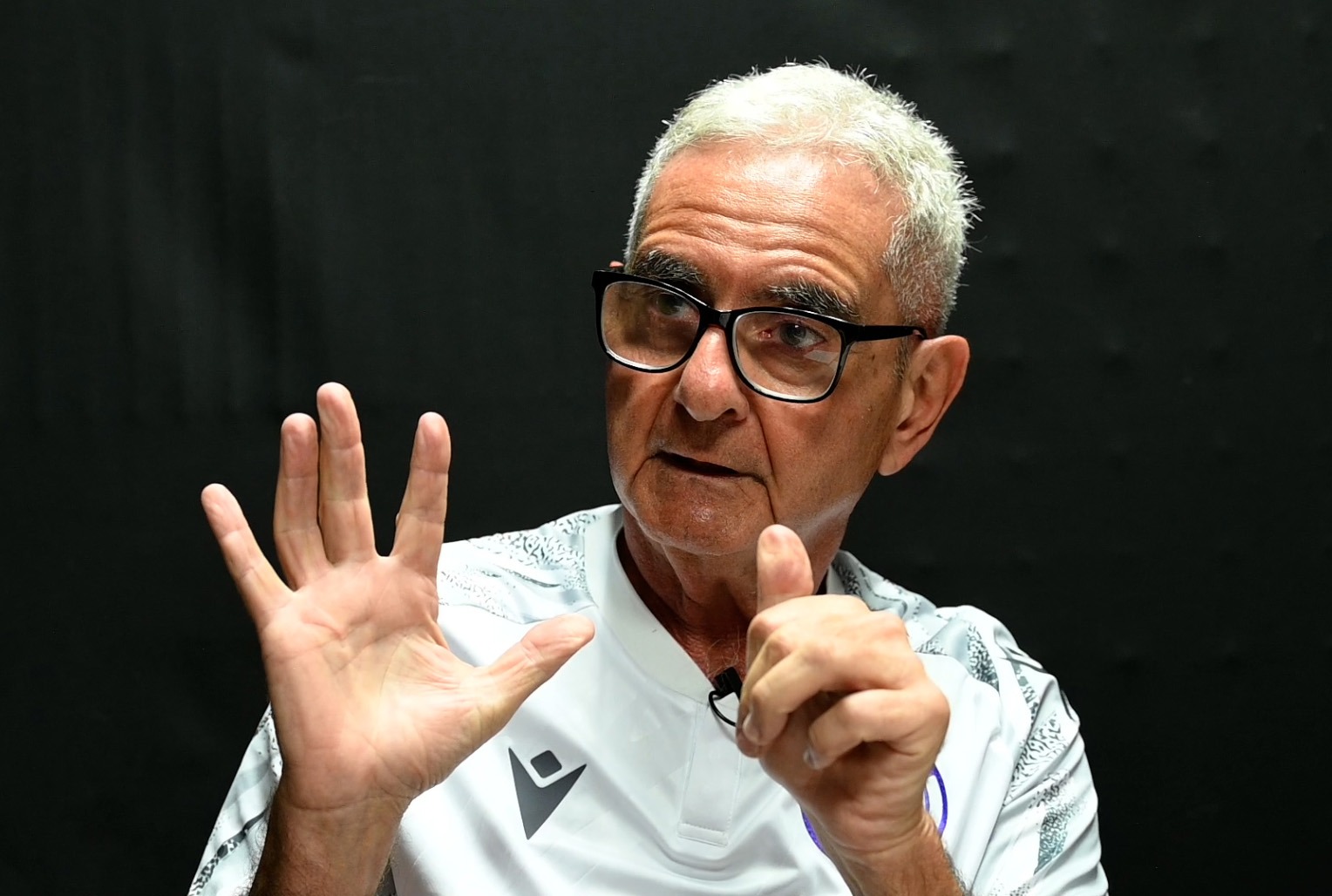
Malta’s disappointing results in this month’s international window have reignited the debate among football fans on our national teams’ lack of progress. Former coach Pippo Psaila sat with Valhmor Camilleri on the SportsDesk podcast and said that it’s all down to our football system…
During the past weeks, the senior national team faced the Euro 2024 semi-finalists, the Netherlands, in a FIFA World Cup qualifier, and as expected, lost the match 4-0.
But a few days later, Emilio De Leo’s men suffered a 4-1 humbling to Bosnia and Herzegovina at the National Stadium. This result left a sour taste within the Maltese fans, particularly given that the team in the past months has been strengthened with several ‘foreign players’ who were handed a Maltese passport.
Pippo Psaila, a former Malta coach, said that if one had to be objective, the team’s performances were not that bad. Still, the team’s inconsistencies proved fatal to any hopes of securing a positive result.
“One has to be realistic and admit that the performances of the team were quite good,” Psaila said.
“The main problem is that during the same match, there were moments where the team started showing signs of inconsistency. At one moment we play well, then something happens and we jeopardise the match, both in terms of the final result as well as from a psychological point of view.
“We are conceding too many soft goals, and that is all down to our poor defensive set-up. The team is trying to push forward and be positive, but is losing shape, and the space between the lines is non-existent, making the team vulnerable to quick transitions.
“And we are ending up conceding goals in our best spells, and that is hard to accept for the players. We are simply unable to kill off games.
“This comes from the fact that the level of our Premier League is quite modest, where we see a lot of walking football, players are too static, there is no high intensity…. the complete opposite of what we see in international football.
“So as you can see, the main problem is not the national team but the football system we are adopting.”
Psaila admits that the influx of foreign players is limiting the time for Maltese players to ensure they have regular football week in week out, leaving national coach Emilio De Leo with a major task of having a bigger base of home-grown talent to choose from.
“Since we have allowed Premier League clubs to have 12, 13, and 14 overseas players, we are limiting the development of Maltese talent who are finding little space to play in the top-flight.
“So, with very few Maltese players playing regularly, tell me with what players the national coach can play on the international stage? Those playing in the Challenge League?
“Our football system has shot itself in the foot. As I said, the problem is not the national team, but it’s a reflection of decisions taken without anyone thinking what effect they would have on Maltese football.”
The Malta FA, over the years, has embarked on several strategies to revive the fortunes of the national teams and appointed several coaches, but still, no real reward has ever been reaped.
Psaila says it’s not about how long someone stays in the job, but how effective these decisions are, and makes a clear example with the impact Ħamrun Spartans coach Giacomo Modica had with the Malta champions.
“Ħamrun Spartans has enjoyed unprecedented success this summer,” Psaila said.
“How long has their coach been there to attain this success, two or three months? Giacomo Modica, in a very short span of time, has assembled a winning team with a winning mentality.
“He adopted a completely different approach from other coaches, which was based not on technical ability but a top-notch physical preparation. Maltese teams can never outplay our opponents from a technical level, but we can outpace them, winning the second ball and keeping a high intensity of play throughout the 90 minutes.
“In football, it’s not about the time you spend in charge, but it’s about the decisions you take and how effective they are to reach your target.”
Psaila said that football at Maltese football at youth level has spiralled out of control and there is little direction.
“We have been waiting for the reform of nursery football for the past five years, but so far nothing has happened,” Psaila said.
“Everyone takes their own decisions and works how they want. There is no direction in the youth football sector. This year, it has been decided that the U-13 football is played during the week, on Monday and Friday, with matches starting at a time when the children have barely returned from school.
“I just don’t understand these decisions. How can a young player go to play a football match after a day at school?
“We are making decisions without thinking about their consequences, and even worse, without a plan.”
Psaila was also critical of the system being adopted by the football hubs, which are taking players from the academies three times a week, giving very limited time to the club coaches to work with their players.
“In Italy, when they realised they had a crisis to produce talented players, they decided to restructure their youth scheme for the national teams and clubs,” Psaila said.
“They appointed Maurizio Viscidi, who created a blueprint, and instead of taking young players from the nurseries, they have brought in selectors who go around Italy to watch youngsters train and play matches.
“Then, six times a year, they select a group of players for a training stage in their regional centres. Here, in Malta, we did the complete opposite, we take the talented players from the nursery and you have barely little time to work with them.
“For me, that is a clear lack of trust towards our coaches who have received their coaching education from the Malta FA Technical Centre.”
Psaila says that Maltese football is crying for a crucial appointment to take the Beautiful Game forward.
“The most important person in football is the Director of Football Development, at the moment we don’t have anyone with that responsibility within the Malta FA,” Psaila said.
“National coach Emilio De Leo brought someone with a view of taking a similar role but after a year in the office I have yet to see any tangible decision taken by him that is changing the way things are run here.
“What is really frustrating is that there is no consultations with nurseries and football academies in Malta. I come from one of the largest academies in Malta but so far nobody phoned me or contacted me to share their vision and hear my opinion.
“There is a lack of consultation with all the academies in Malta. You cannot confine yourself at Ta’ Qali and have no communication with the clubs who are the heart of football.
“Maltese football is crying for a defined strategy at the youth level, which is shared with the clubs, to try and address all the issues.
“Unless we do that I can’t see any immediate improvement in the next few years.”














Matthew Galea
October 26, 2025 at 2:57 pm
bizarre commentary from Psaila.
my son is at Luxol, he is more interested in money, the uniforms and punctuality than development of the players. Coaches have no autonomy and defer to the Technical Director on every issue.
The Takeover of Pembroke has been a disaster, 700E a year this year Vs 400 for Pembroke previously