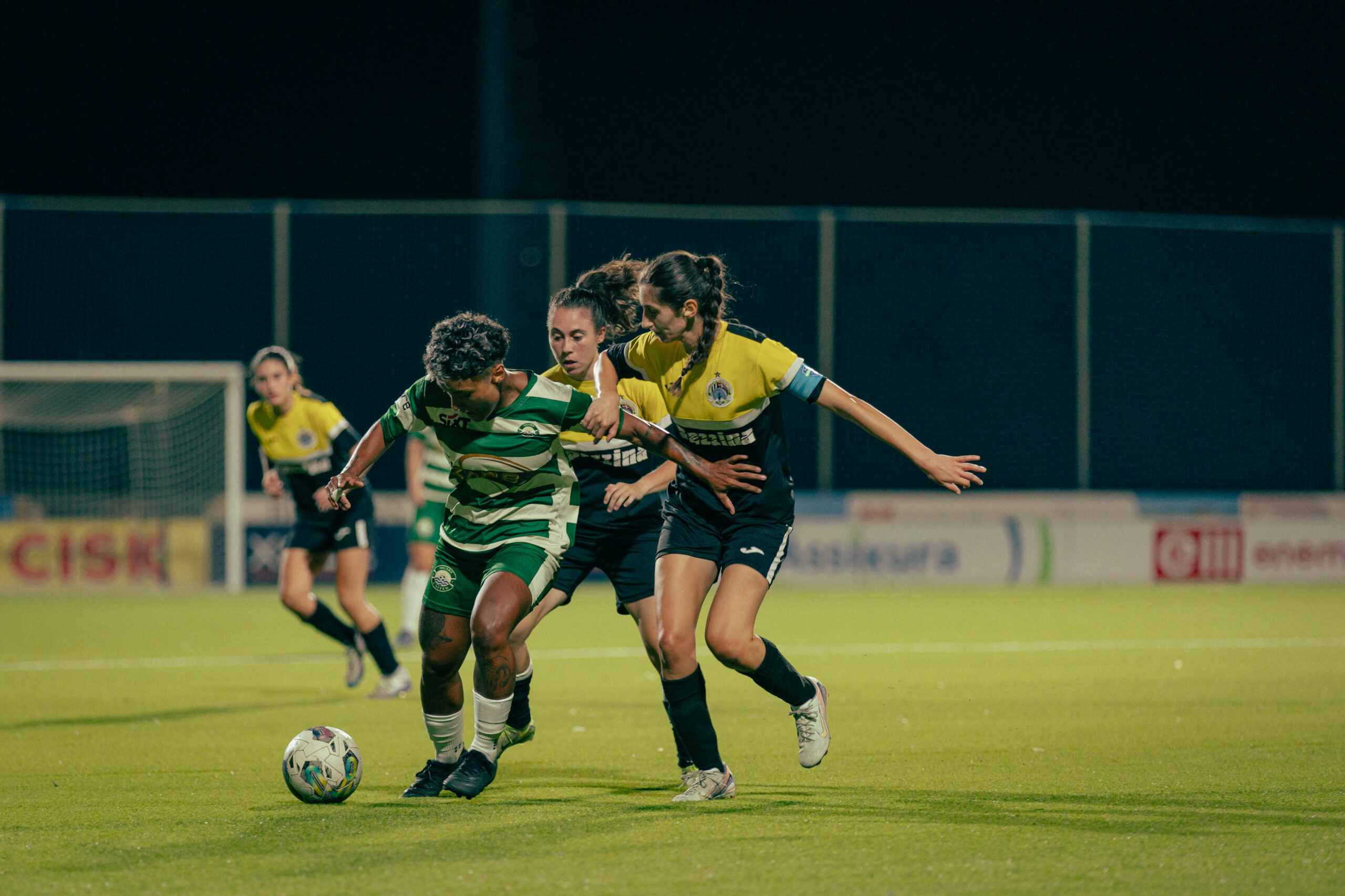
Mġarr United and Hibernians will contest this season’s special edition of the Malta FA Jubilee Cup in Monday’s final (kick-off: 2.30pm).
The final will be staged at the National Stadium, opening a busy programme of events marking the Malta FA’s 125th anniversary celebrations, which will later include a commemorative activity and the men’s competition final.
This will be the first women’s club final held at Malta’s main stadium since the 2019 Super Cup between Birkirkara and Mġarr. It will also be the second women’s match played at the venue in 2025, following the senior national team’s promotion-sealing 1-0 win over Cyprus in the UEFA Women’s Nations League earlier this year.
“Obviously, a final always brings a certain amount of pressure with it automatically, but I think that playing this match at the National Stadium will make the occasion even more special. There will be more eyes on the game, and the players will be experiencing something out of the ordinary,” Mġarr coach Ryan Vella told the Times of Malta.
“We are really looking forward to this opportunity. Even though the conditions may be a bit different from the usual, playing at the National Stadium is always something special. All the players are eager for it. A final is always a final, and the team is very motivated to give it their best shot,” Martina Borg, coach of Hibernians, explained.
All six Assikura Women’s League teams took part in this competition, with Mġarr eliminating Swieqi United in the semi-finals while Hibernians advanced past Birkirkara. Both sides entered the tournament at the semi-final stage after receiving byes.
The two finalists know each other well, currently battling at the top of the league standings. Mġarr arrive with a perfect record of nine consecutive victories and remain unbeaten, while Hibernians trail by eight points.
“They are very quick in transitions and play directly into their fast forward line. They are also defensively compact, so we will need to remain patient and choose our moments carefully,” Borg underlined.
Mġarr, however, have tasted defeat once this season – in the Super Cup final, where they were beaten by Swieqi United.
Coach Vella hopes that setback can further strengthen his side, using the lessons learned from that loss to push for victory in this one-off trophy.
“The strongest aspects helping us this season are that we didn’t have many changes from last year. We kept the same players and added some younger ones to give us more numbers in certain departments,” he said.
“After the Super Cup defeat, the team bonded even more than before, and I believe that helped us start the league campaign strongly. But we also know that there is still a lot of football to be played.”
In their only league meeting against Hibernians so far this season, Amber Grech scored the decisive winner for Mġarr. Remarkably, the teams will meet again just four days after the final for their second league encounter – a match that could already prove influential in the title race despite December having only just begun.
“Although it will be a very nice experience for us to play at the National Stadium, I believe that for this match – especially against a team like Hibernians – it will be a bit of a disadvantage for us. This is mainly because we will be playing on a pitch we are not used to (natural grass), while Hibs train regularly on this type of surface (at the Hibs Stadium),” Vella pointed out.
“However, on the other hand, we also know that an experience like this does not come often, and our job is to work hard to achieve the best possible result and give a good showcase for women’s football in general. Hopefully, we can start seeing these types of matches played at the National Stadium more frequently, attracting more media attention and encouraging football fans to follow the women’s game more.”
Hibernians’ coach Borg, on her part, said: “There are both positive and negative aspects. On the positive side, it’s the biggest stage one can play on locally. On the other hand, the pitch is larger than what we’re used to, which could affect the intensity of the game. We also don’t usually play on natural grass, so that might pose a challenge and influence our style of play.”
Under coach Vella, Mġarr have made significant progress since last season, underscored by their first-ever major honour in the women’s game – last year’s Assikura Women’s Knock-Out, won against Hibernians. They retained the core of last year’s squad while making targeted additions to strengthen depth and quality. New signing Josline N’Guessan has been particularly impactful, leading the club’s scoring charts with seven goals, closely followed by Maria Hernandez and Valeria Villegas with six each. The team has also been boosted by the return of experienced midfielder Brenda Borg, who recently celebrated her 80th Malta cap during the friendly against Croatia.
Hibernians, meanwhile, are under the fresh leadership of Martina Borg, in her first season as a senior-team coach. A former club captain, Borg played in three consecutive cup finals with the Paolites – all of which ended in defeat – and will be eager to begin a new chapter from the touchline.
”It has been challenging but very rewarding. This group of players is truly special, and I feel lucky to be their coach. Their work ethic is excellent, and they are always willing to learn. They are definitely making the transition easier for me, and I’m grateful for the opportunity to coach this team,” Borg said when asked about her coaching experience so far.
Midway through the campaign, Hibernians strengthened their squad with two additions, including Uganda international Sylivia Kabene, who has already netted six goals for the club.
FVS support
For the first time in the local women’s game, Football Video Support (FVS) will be used in this final.
Already implemented in men’s competitions, FVS is used in the following scenarios:
- The FVS system is used only in the event of a possible clear and obvious error or serious missed incident in relation to the following scenarios: a. Goal/no goal b. Penalty/no penalty c. Direct red cards (not second cautions) d. Mistaken identity (when the referee cautions or sends off the wrong player of the offending team).
- FVS can be used only once the referee has made a decision (with waving play on being considered a decision) and a team has made a subsequent request for a review.
- Only the team’s head coach (or, in their absence, the senior team official present in the technical area) can make a review request, which must be made immediately after the incident, by twirling their finger in the air and giving a review request card to the fourth official. However, each player is entitled to ask their head coach to make a review request.
- The fourth official will inform the referee of the review request and, if play has stopped (and not restarted) since the incident, the referee will go to the referee review area (RRA) to review the replay footage. If play has continued since the incident, the referee will stop play when the ball is in a neutral zone and go to the RRA to review the replay footage.
- During the review, the referee will be assisted by a review operator, who will show replay footage on the monitor (e.g. different camera angles, split screen, different replay speeds, etc.).
- The original decision taken by the referee will not be changed unless the video replay footage shows clear evidence that the decision was a clear and obvious error or that there has been a serious missed incident.
- As the FVS system involves a small number of cameras, the replay footage will often be inconclusive and thus the original decision may not be changed.
- The review request must be made immediately to: • conform to the Laws of the Game requirement that a decision cannot be changed once play has restarted after a stoppage; and • prevent unnecessary delays to the game while the team’s head coach considers whether to make a review request.
- After a goal has been scored, the fourth official will check the footage on the monitor and inform the referee if a clear and obvious offence was committed by the attacking team. Unless the decision is factual, the referee will then review the incident and make the final decision.
- During the trial phase, it is expected that each team will be able to make two requests per match. If the review by the referee results in the original decision being changed, the team retains (does not lose) that review request.