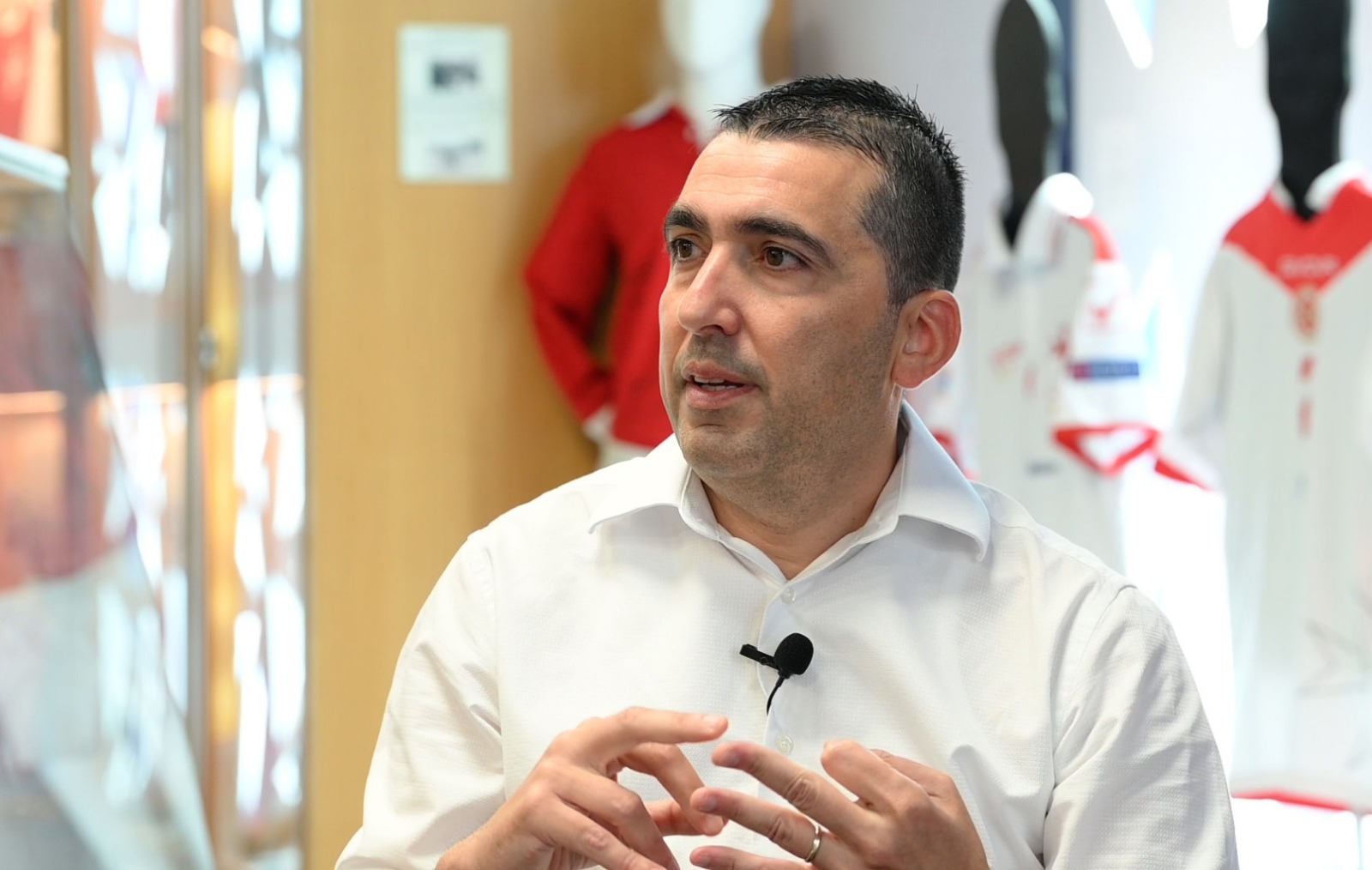
Maltese football is just weeks away from a major change with the introduction of the Football Video Support. Alan Mario Sant sat down on the SportsDesk podcast and told Valhmor Camilleri that he wants referees to show their personality and take decisions instead of just relying on technology…
The importance of having video technology has been a topic that has dominated local football punditry for several years now.
With the introduction of the Football Video Support system in domestic competitions, on a trial basis, Maltese football will make a breakthrough.
Still, it’s guaranteed that controversy and discussion on how it is used by match officials will get even more scrutiny from all major stakeholders in the game.
Alan Mario Sant, the chairman of the Referees Committee within the Malta FA, said that the local governing body has been planning to introduce technology in Maltese football for several years now.
“The use of video technology in Maltese football is something that it has been discussed for several years,” Sant said.
“Malta was one of the first countries that showed interest, but our financial and infrastructural limits stopped us from introducing technology before.
“Thus, this year, the Malta FA was allowed by FIFA to make use of the newly-launched Football Video Support trial. FIFA published an expression of interest in the project, and Malta was one of the first countries to apply and trial the system.
“After a thorough study of the system, the MFA Executive Committee agreed that we should introduce FVS on a trial basis in collaboration with FIFA.
“This is a major milestone for Maltese football, and I believe that the system will make the game fairer as the referee will have the opportunity to amend his decision if a clear and obvious error was committed.”
Sant said that there are a lot of differences between the FVS and the VAR system.
“There is a clear distinction between the FVS and the VAR system,” Sant said.
“FIFA introduced the Football Video Support for those associations that do not have enough finances to install the VAR system.
“It’s a less complicated system than VAR, with fewer cameras and resources used, and a different software system.
“You don’t need a referee sitting in a VAR Room to check all the actions from the match, but in the Football Video Support, you have the fourth official, who, when the coach challenges a referee decision, will call the referee to check the action and decide whether a clear and obvious error has been made.
“Every coach will have two challenges at his disposal, and when he successfully challenges a decision, he will keep the challenge, but if he fails to overturn the decision, he will lose it.
“It’s important to point out that a decision will be overturned if there is a clear error. If there is a millimetric offside decision, the referee will likely stand by his decision, and if there is a doubt, it will favour the forward as the Laws of the Game state.”
Sant said that the Football Video Support will not solve all the problems.
“If you look at the VAR decisions, they are still being discussed days after the match,” he said.
“Having a healthy discussion on a controversial decision is what makes football so popular, and it will remain there. We will only eliminate clear and obvious errors made by officials.”
Sant said that Maltese referees have been receiving training on VAR technology since 2023 and will be well prepared to use the system.
“Our officials have been given training on VAR technology since 2023 when the MFA took the decision so that our officials will not be put on a disadvantage with fellow referees from other countries when it comes to receiving international assignments,” Sant said.
“The Referees Committee met with UEFA and together we implemented a strategy where Maltese officials were trained and certified on VAR, and it was a system that was well received.
“Training was done in Malta and worked out well as today we have referees who are being assigned matches at all levels, from Play Off Round to the group stages of UEFA club competitions.
“Our officials are already well prepared for technology and in our pre-season training we started discussing Football Video Support, and now, once the suppliers will bring the necessary equipment, we will start on-pitch training to ensure our officials will be ready to use it when the system comes into operation.”
Sant said that it will be crucial that the positioning of the cameras is done well, as that will define how effective the system will be.
“We are planning to have between four to six cameras around the pitch, but the most important thing is that they are positioned at a good angle to ensure we give officials the best possible view to review disputable decisions,” Sant said.
Sant made it clear that every decision taken by referees is dictated on a set of criteria set by FIFA and UEFA according to the Laws of the Game.
“Every decision taken on the football pitch by the referee is taken according to the instructions we receive from FIFA,” Sant said.
“A referee decides if a player is shown a red card for violent challenge according to a set of criteria that he needs to follow. He has to assess how he came to a point to make contact with the opposing player, the intensity of the challenge, the position of his foot and many more. And that will guarantee consistency in the decisions taken by our officials.
“At the start of the season, we hold meetings with the captain and coaches of each club to
discuss the instructions we are given by FIFA on certain situations and may be give them information on new regulations that they may not be familiar with.
“A referee does not say I think it was a foul but says it’s a foul because of this, this and this. It’s a standard procedure.”
Since the introduction of the VAR technology it has become a common occurrence among some referees that they tend to opt against taking a decision but wait to be called by the VAR referee who would give him instructions on whether an offence was committed in a certain decision.
Mentality change
Sant made it clear that it’s imperative that Maltese referees show their personality and continue to make decisions, even when technology is introduced, as that helps officials to gain credibility with players, coaches and fans in general.
“We are in a similar situation to when VAR Technology was introduced when officials were forced into a change of mentality,” Sant said.
“When VAR was introduced there had to be a mentality change as the referee, who always had to decide by himself, had to accept that someone else could come in and change his decision.
“Now we have gone to the other extreme where officials refuse to make big decisions and let the technology rule what is the right call and that is not good.
“This is something that UEFA and FIFA do not want. We want officials to show their personality on the pitch. One thinks that the referees are only there to award penalties, goals and give red cards, but in reality, referees have to take control of a football match and when there is a key situation where you fail to make a decision, you lose your credibility.
“With every game a referee officiates, he is building his reputation, and once you rely on technology that respect you gained weakens and the referee is not credible anymore.”
Referees are always subject to errors and it’s a common question made by football fans about whether officials are sanctioned when they commit a major and clear error in big matches.
Sant said that the Referees Committee takes disciplinary action against officials but it cannot be made public, according to UEFA regulations.
“The Referees Committee does take action on officials who commit errors in matches,” Sant said.
“We can’t go public on the action taken but someone who follows football will realise that one official has been given a short break the following match. But that decision is taken to ensure that he is well prepared for his next assignment.
“A lot of work is done with officials, both individually and as a group. In the Premier League, there is a referee observer who reports the performance of the referee and gives feedback to the official after the match on how he can improve.
“After the match, the referee also speaks with a member of the Referees Committee to express how he felt when taking certain decisions. A deep analysis is done and the main aim is to help the official to do better in the next game.
“As a group, we hold meetings after every three match days where we show some incidents and have an open discussion on what should have been done.
“It’s always a very mature conversation, and once the session is finished, we ensure that every official leaves the meeting with the same view of what had to be done to ensure there is consistency in decision-making by all officials.”