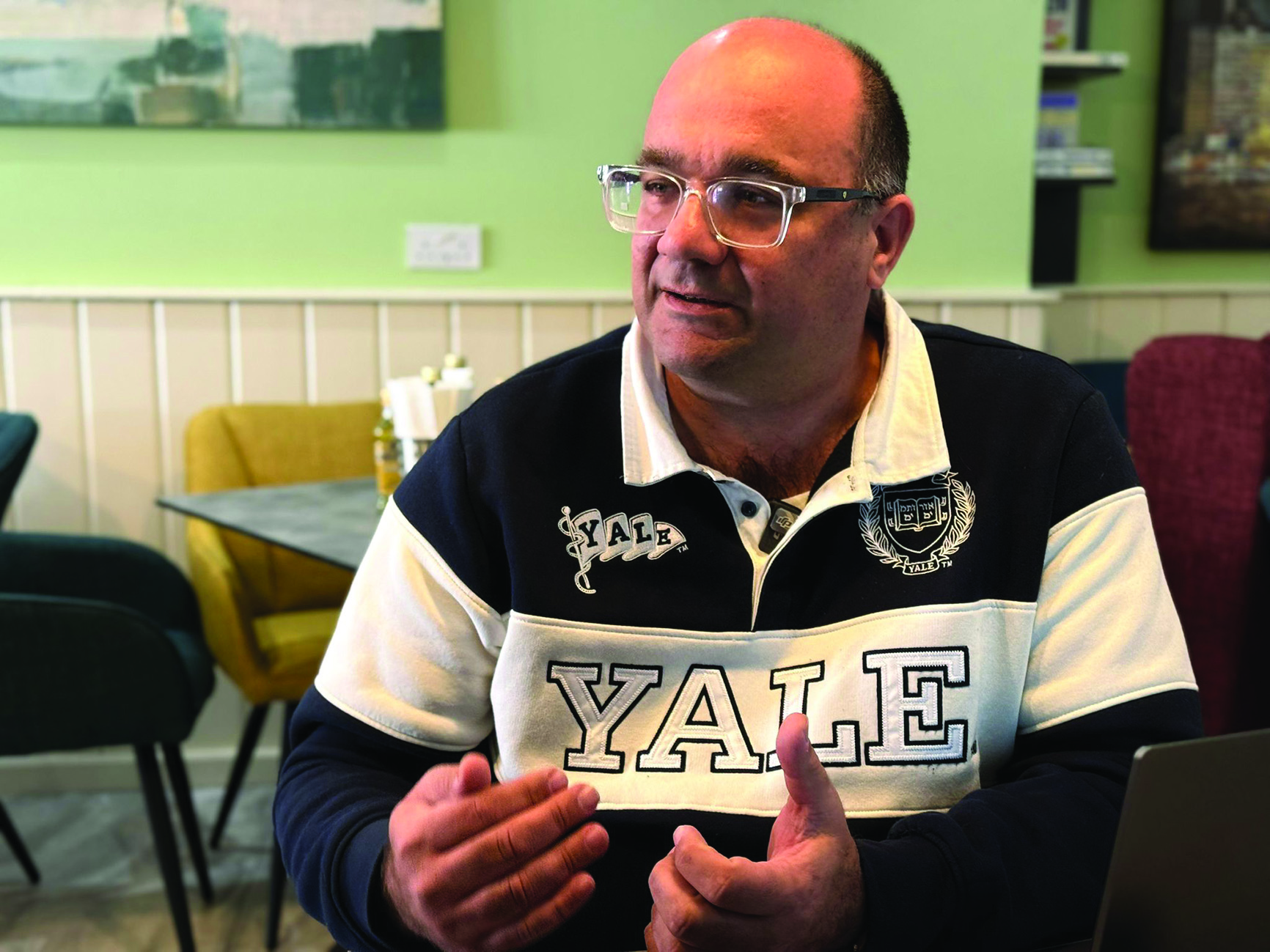
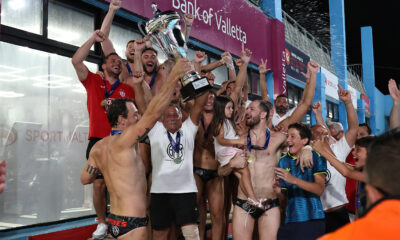
San Ġiljan ASC secretary Carlo Mifsud has defended the new homegrown regulations approved by the Aquatic Sports Association Council meeting and said that the changes made were not aimed at new Neptunes player Ivan Nagaev but to ensure that no team has a competitive advantage over the others as from next summer’s National Championship.
Mifsud spoke to the Times of Malta in reaction to last week’s SportsDesk podcast, during which Neptunes president Matthew Bonello accused San Ġiljan and the other clubs of approving a motion that was not only discriminatory against Nagaev but also goes against Maltese laws, the constitution, and the regulations of the European Union.
The ASA Council approved a motion, submitted by San Ġiljan and supported by several other top water polo clubs, that ruled that every club should have only one non-homegrown player in the water.
However, San Ġiljan contended that homegrown players are those who participated in ASA-recognised local junior competitions for a minimum of three full competitive seasons between the ages of 12 and 20.
Added to that, any player who was eligible to participate in senior competitions as a Maltese national up to the end of season 2025, under the statutes and regulations then in force, may continue to be registered and fielded as a home-grown player.
According to the new regulations, Nagaev cannot play as a Maltese player for his new club Neptunes, despite the fact that he was handed a Maltese passport last November and represented the national team at the European Championship in Belgrade last January.
Mifsud said that Neptunes’ decision to register Nagaev as a Maltese player went against a gentleman’s agreement that existed between the clubs for several years, which ensured that foreign players who are handed a Maltese passport would still have a non-homegrown status.
“The motion submitted by our club, San Ġiljan, and which was supported by several clubs, was passed by a clear result of seven votes in favour and one against, so there was a major consensus about it,” Mifsud said.
“The clubs have been working on this motion for several weeks and is based on a gentleman’s agreement that has existed between all clubs for several years that stated that whoever is given a Maltese passport on merit, will continue to be regarded as a foreign player.
“This was also confirmed in the letter sent by ASA president Karl Izzo on November 27, where he said that he wanted Ivan Nagaev for the national team’s commitments in the European Championship finals.
“Added to that, when Nagaev was playing with Valletta, he held a foreigner status, and the club agreed to stick with this gentleman’s agreement, and maybe the mistake we made is that we didn’t put it in writing and trusted everyone, as when you have an agreement, one expects that everyone will honour it.”
Mifsud said that the reason why this motion was not passed through the ASA’s annual general meeting is that the ASA had confirmed to the clubs’ rumours that Nagaev would be given a passport to play for the national team just a few days before the AGM.
“The clubs received this notice on November 27, just two days before the AGM, and according to our regulations, clubs that wanted to propose a motion had to give a 15-day notice before the AGM, so we could never present our proposal during the AGM,” Mifsud said.
“Therefore, we could only propose it in our next opportunity, which was the ASA’s Council meeting.”
Mifsud said that this motion was based on the idea of introducing the homegrown concept that is used by other governing bodies, like the Malta Football Association.
“This regulation is aimed at creating a level playing field between all clubs. In water polo, a team has seven players and if one club brings in a foreign player who is given a homegrown status, that level playing field is taken away as it gives that club an unfair advantage,” Mifsud said.
“Added to that, this motion is aimed at protecting young Maltese talent from being denied the opportunity to play regularly at our clubs.”
Mifsud has denied the accusation that the motion was made midway through the season, as he says that in Malta, there is the winter season, which includes the Enemed Cup and the Winter League, and the summer season, where the National Championship is played.
“This motion was passed for the summer season, which will start in five months.”
During the discussion, Mifsud questioned how Nagaev managed to be awarded a passport in just a few weeks to play for Malta and sign for Neptunes while when Valletta made an application, so that Nagaev is given a Maltese passport, the process lasted a year and was not approved and was withdrawn.
Mifsud also questioned the position on good governance taken by the Authority for Integrity in Maltese Sport (AIMS) and said that during the last two years, there were several disciplinary cases, including one where someone tried to stop a doping case, and questioned why AIMS didn’t intervene in that instance.
Questioned why San Ġiljan and the other clubs wanted to proceed with this motion despite the opposition from Dr Herman Mula, the legal advisor of the ASA, who asked clubs to delay the vote and take advice from the legal advisors, Mifsud said: “We didn’t follow Dr Mula’s advice as we had been speaking with our lawyers for several weeks.
“Added to that, in life, you sometimes go to one lawyer, and he gives you a particular piece of advice, and then you speak to another lawyer, and he has a different opinion.”
Nagaev is not the first foreign player to be awarded a Maltese passport and play for the national team, as in 2015 Aurelien Cousin was also naturalized as a Maltese citizen and during that time, he played as a homegrown player for both San Ġiljan and Exiles.
But Mifsud said that the two cases were completely different.
“There is a big difference between the two cases, as at the time Aurelien Cousin had been in Malta for four years and he could not play in our competitions,” Mifsud said.
“He was not on the same technical level as the foreign players that featured at the time. On the other hand, he was coaching in Malta for three to four years, and he was surely giving something back to the sport.
“Aurelien was given his passport not on merit but after he married a Maltese woman, and it was after he acquired the passport that the ASA had said at the time that they might consider him for the national team after he had received the passport.
“So the situation is completely different, and certainly it’s not a case of two weights and two measures between the two situations.”